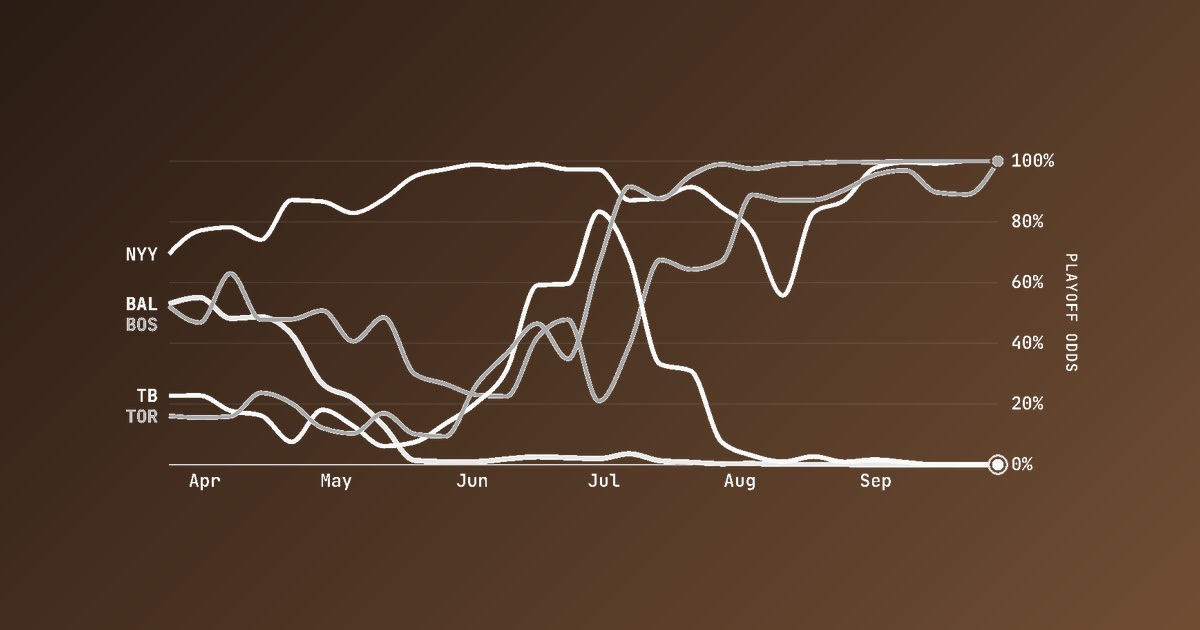

Welcome in data and analytics nerds. If you are curious about the model Birdland Metrics built to predict the Orioles (and other AL teams) odds for the 2026 season, you've come to the right place. I'll do a deep dive on the model's layers, how it works, what it does well, and outline it's blind spots. So, crack open a Natty Boh and start reading...
The Short Version
Birdland Metrics uses an ELO rating system, similar to the model format used by the late FiveThirtyEight.com — adapted for baseball and enhanced with several additional layers:
ELO ratings track team strength based on game results, updated daily
Starting pitcher adjustments shift each game's probability based on who's on the mound, using FIP (Fielding Independent Pitching)
Probability calibration corrects for ELO's tendency to be overconfident
Preseason projections blend mean-reverted ELO with FanGraphs team WAR forecasts, fading into in-season performance over the first 100 games
In-season injury adjustments penalize teams for WAR lost to the injured list
These layers feed into a Monte Carlo simulation that plays out the rest of the season 10,000 times, producing the playoff odds and win projections you see on the home page.
Layer 1: ELO Ratings
Every Team Gets a Number
Each of the 30 MLB teams carries an ELO rating — a single number that represents its current strength. The league average is 1500. A dominant team might sit around 1650-1700; a rebuilding team might drop to 1300-1350.
After every game, the winner gains ELO points and the loser drops by the same amount. The system is zero-sum: meaning points don't appear out of thin air. Our ratings chain extends all the way back to the year 1871 (that's right, 6 years post US Civil War) — over 230,000 games — recomputed from scratch with one consistent formula.
How ELO Predicts Games
Before each game, the model computes a win probability using the rating gap between the two teams, plus a home field advantage of 55 ELO points (roughly equivalent to a 58% win probability for two evenly-matched teams at home, consistent with MLB's historical home winning percentage).
The formula is the standard logistic ELO equation:
P(home wins) = 1 / (1 + 10^((ELO_away - (ELO_home + 55)) / 400))
In plain English: the bigger the ELO gap, the more confident the prediction. A 100-point advantage translates to roughly a 64% win probability.
Blowouts Matter More
Not all wins are created equal. A 10-1 rout tells us more about team quality than a 3-2 walk-off. After each game, the rating shift is scaled by a margin of victory multiplier that uses a logarithmic formula:
MOV = min(log(|run_diff| + 1) x (2.2 / (0.001 x |elo_diff| + 2.2)), 1.25)
The logarithm compresses extreme blowouts — a 15-run win isn't five times more informative than a 3-run win. The dampening term ensures that when a heavy favorite blows out a weak opponent, the ratings don't overreact (that result was expected). The multiplier is capped at 1.25 to prevent any single game — no matter how lopsided — from producing an outsized rating swing.
Run Differential | Rating Shift Multiplier (even matchup) |
|---|---|
1 run | 0.69x |
3 runs | 1.10x |
5 runs | 1.25x (capped) |
10 runs | 1.25x (capped) |
How Much Each Game Moves the Needle
The sensitivity of ELO updates is controlled by the K-factor, set to 6. This means a single game shifts ratings by at most a few points — the model prioritizes stability over reactivity. A lower K-factor is appropriate for baseball's 162-game season, where signal accumulates slowly across hundreds of games. Over the course of a season, the cumulative shifts still produce meaningful separation between the best and worst teams.
shift = K x MOV x (result - expected) = 6 x MOV x (result - expected)
Worked example: Home team (1500 ELO) beats away team (1400 ELO), score 5-2:
Expected win probability: 0.648
Score difference: 3 runs, raw MOV: 1.33, capped MOV: 1.25
Shift: 6 x 1.25 x (1 - 0.648) = 2.64 ELO points
Layer 2: Starting Pitcher Adjustment
The Problem ELO Can't Solve Alone
ELO captures how good a team is overall, but it's blind to who's pitching today. The Orioles send Kyle Bradish to the mound in one game and a back-end starter the next — their ELO is the same in both cases, even though their actual chances of winning are very different.
FIP: The Pitching Metric That Matters
We use FIP (Fielding Independent Pitching) rather than ERA to evaluate starters. FIP strips out the noise of defense, sequencing luck, and batted ball variance, isolating the outcomes a pitcher directly controls: strikeouts, walks, hit-by-pitches, and home runs.
FIP = ((13 x HR) + (3 x (BB + HBP)) - (2 x K)) / IP + cFIP
The cFIP constant anchors FIP to the league-wide ERA scale so that the average FIP equals the average ERA in any given season.
Converting FIP to a Win Probability Shift
Before each game, we compare each starting pitcher's FIP to the league average. The difference is converted into an ELO adjustment at a rate of 50 ELO points per 1.0 FIP:
adjustment = (league_FIP - pitcher_FIP) x 50
A pitcher with a FIP one full point below league average (an ace) adds 50 ELO points to their team's effective rating for that game. A pitcher one point above average (a struggling starter) subtracts 50 points.
To put this in context with real pitchers:
Pitcher | FIP | Adjustment |
|---|---|---|
Elite ace (2.35 FIP) | 2.35 | +90 ELO pts |
League average | ~4.15 | 0 |
Back-end starter (6.05 FIP) | 6.05 | -95 ELO pts |
That's a swing of nearly 185 ELO points — or roughly the gap between a 95-win team and a 75-win team — based solely on who's pitching. The starting pitcher is the single most impactful per-game variable in baseball, and FIP captures it cleanly.
When a starting pitcher hasn't been announced or has no FIP data yet, the model simply assigns league-average FIP (zero adjustment), falling back to the raw ELO prediction.
Important note: The model uses raw FIP directly — no regression or blending is applied to individual pitcher FIP values. We tested Bayesian regression (blending observed FIP toward the league average weighted by innings pitched) but found that at end-of-season granularity, pitchers have accumulated enough innings for raw FIP to be stable. See Features We Tested and Rejected below for details.
Layer 3: Probability Calibration
ELO Has an Overconfidence Problem
Raw ELO probabilities are systematically too extreme. When the model says a team has a 70% chance of winning, they historically win closer to 64% of the time. This is a known property of ELO systems — the math maps rating differences to probabilities more aggressively than real-world outcomes justify.
The Fix: Shrinkage
We apply a simple linear compression that pulls all probabilities toward 50%:
P_adjusted = 0.16 + (1 - 2 x 0.16) x P_raw
This means the model never predicts any team has less than a 16% chance — or more than an 84% chance — of winning any individual game. That floor reflects the inherent unpredictability of baseball: even the worst team in the league beats the best team roughly one in six times.
Raw Prediction | After Calibration | Change |
|---|---|---|
80% | 70.4% | -9.6 points |
70% | 63.6% | -6.4 points |
60% | 56.8% | -3.2 points |
50% | 50.0% | unchanged |
Why 0.16?
The shrinkage parameter was optimized through a grid search across 150 parameter combinations, evaluated across three full MLB seasons (2023-2025). Surprisingly, this simple calibration is the single most impactful enhancement in the entire model — it improved prediction quality more than the starting pitcher adjustment.
Layer 4: Preseason Projection
The Offseason Changes Everything
ELO ratings carry over from the prior season, but rosters can transform over the winter. A team that loses star players in free agency and replaces them with a mix of veterans and prospects enters the season measurably different — but ELO has no way to know this until enough new games are played for the rating to "catch up."
Two Signals, One Preseason Rating
Before Opening Day, the model constructs a preseason ELO for each team by blending two independent signals:
Signal 1: Mean-Reverted ELO. End-of-season ELO ratings overstate the gap between the best and worst teams because some of that gap is luck. Before carrying ratings into the new season, the model regresses every team 40% toward the league average of 1500:
mean_reverted = 0.6 x end_of_season_elo + 0.4 x 1500
A team that finished at 1650 starts the new season anchored at 1590. A team at 1350 moves up to 1410. This compression reflects the historical tendency for teams to regress toward the middle — last year's best team rarely stays the best, and last year's worst team rarely stays the worst. An additional spread compression factor of 0.75 further tightens the ratings, preventing any single dominant team from distorting the preseason landscape.
Signal 2: Team WAR. WAR (Wins Above Replacement) measures total roster talent on a single scale. A team with 48 WAR has a roster roughly 9 wins better than a 39-WAR team, all else equal.
For the current season, we use FanGraphs Depth Charts projected WAR — pre-season forecasts that account for aging curves, injury risk, and expected playing time. The model automatically fetches updated projections daily during February and March from the FanGraphs API, aggregating batting and pitching WAR across all ~1,400 projected players. Each team's total WAR is converted to an ELO-scale rating centered on 1500:
war_elo = 1500 + (team_war - league_average_war) x 5.0
A team with WAR 8 points above the league average gets a WAR-based ELO of 1540. A team 8 points below gets 1460.
Blending the signals. The final preseason ELO is a 50/50 blend of the two signals:
preseason_elo = 0.5 x war_elo + 0.5 x mean_reverted_elo
This blending is deliberate. Mean-reverted ELO carries information about organizational quality, coaching, and intangibles that WAR doesn't capture. WAR captures roster talent that end-of-season ELO hasn't yet processed — particularly offseason moves. Neither signal is sufficient on its own; the blend outperforms either individually in backtesting.
Tracking Projection Changes
Because the model fetches fresh FanGraphs projections daily during the preseason, it also archives player-level WAR snapshots and computes day-over-day changes. Each run saves a snapshot of all ~1,400 players' projected WAR, then diffs it against the previous day's snapshot. The result is a per-team change report showing which players' projections moved and by how much — useful for understanding why a team's preseason ELO shifted from one day to the next.
2026 Example
Using FanGraphs projected WAR for the 2026 season:
Team | Projected WAR | Mean-Reverted ELO | WAR ELO | Preseason ELO |
|---|---|---|---|---|
LAD | 56.6 | 1611 | 1586 | 1577 |
NYY | 47.5 | 1605 | 1540 | 1558 |
TOR | 48.0 | 1569 | 1543 | 1545 |
BAL | 45.4 | 1506 | 1530 | 1516 |
DET | 44.3 | 1486 | 1524 | 1507 |
COL | 23.1 | 1376 | 1418 | 1426 |
Notice how the blend works in practice: The Dodgers start highest because they combine a strong 2025 ELO with the league's best projected roster. Detroit's projected WAR (44.3, 10th in MLB) pulls their preseason rating up from a below-average 2025 ELO, reflecting their improved roster. Colorado's combination of weak prior results and the league's lowest projected WAR puts them at the bottom.
Fading Into the Season
The preseason ELO doesn't persist all year. As games are played, the model gradually shifts from the preseason anchor toward each team's in-season ELO:
effective_elo = (games_played / 100) x current_elo + (1 - games_played / 100) x preseason_elo
For the first game of the season, the effective rating is almost entirely the preseason ELO. By game 50 (late May), it's a 50/50 mix. By game 100 (early July), the preseason signal has fully faded and the model relies entirely on current performance.
The fade rate of 100 games was determined through backtesting across the 2024 and 2025 seasons, testing fade values from 0 (no preseason influence) to 300 (preseason persists deep into September). A 100-game fade produced the best early-season prediction accuracy while allowing the model to fully adapt by the second half.
Limitations We're Transparent About
Historical seasons use prior-year WAR, not projected WAR (which doesn't exist for past seasons). The backfill for 2024 and 2025 uses actual WAR totals from the prior year plus offseason transaction adjustments as a proxy.
Projected WAR isn't perfect. FanGraphs projections are the best publicly available forecast, but they still miss on players who break out or collapse unexpectedly.
Prospects and minor leaguers with no MLB track record receive no WAR credit. Teams adding top prospects via trade get no preseason boost until those players accumulate MLB stats.
Layer 5: In-Season Injury Adjustment
Injuries Change the Math
A team's ELO rating reflects its results with a full roster. But when a key player lands on the injured list, the team that takes the field is measurably weaker than the one that earned those wins. The model accounts for this by applying a WAR-based penalty for every player currently on the IL.
How It Works
Each day, the model pulls the current injured list for every team. For each IL player, it looks up that player's FanGraphs WAR via pybaseball — using current-season data when available, falling back to the prior season for players injured early in the year. The total WAR on the IL is converted to an ELO penalty:
injury_penalty = -1 x total_IL_WAR x 5.5
This penalty is applied to the team's effective ELO rating at projection time — it doesn't permanently alter the base rating. When a player returns from the IL, the penalty automatically disappears from the next day's projections.
IL WAR Lost | ELO Penalty | Rough Win Impact |
|---|---|---|
1.0 WAR | -5.5 pts | ~1 projected win |
3.0 WAR | -16.5 pts | ~3 projected wins |
5.0 WAR | -27.5 pts | ~5 projected wins |
10.0 WAR | -55 pts | ~10 projected wins |
A team that loses its ace and a star position player to the IL at the same time could easily be down 30-40 ELO points — enough to meaningfully shift their playoff odds.
Only Positive WAR Counts
Players with zero or negative WAR don't generate a penalty when injured. Losing a replacement-level player to the IL doesn't weaken the team — the replacement's replacement performs about the same.
Putting It All Together: Monte Carlo Simulation
10,000 Seasons, One Pipeline
Every day during the season, the model simulates the rest of the MLB schedule 10,000 times. For each remaining game in each simulation:
Look up both teams' current ELO ratings, adjusted for injuries
If starting pitchers are announced, apply their FIP adjustments
Compute the calibrated win probability (with shrinkage)
Flip a (weighted) coin — if the random number falls below the probability, the home team wins that simulation
Each simulation produces a complete set of final standings. From 10,000 sets of standings, we extract:
Projected wins — the median and distribution (including the 10th-to-90th percentile range you see on the site)
Playoff odds — the percentage of simulations where a team finishes in the top 6 of their league
Division title odds — how often they win their division outright
Wild card odds — how often they make the playoffs as a wild card
Why Monte Carlo?
A simple projection might say the Orioles will win 85 games. But what's the range? In how many of those 10,000 simulations do they win 90+? Or fall below 80? The distribution matters more than the point estimate, especially for a team sitting on the playoff bubble. A team projected for 85 wins with a wide range (78-92) has very different playoff odds than a team projected for 85 wins with a narrow range (82-88).
Does It Actually Work?
We backtested the model across three full MLB seasons (2023-2025), with parameters tuned on 2025 and validated out-of-sample on 2023 and 2024.
Season | Model | Accuracy | Log Loss | Brier Score |
|---|---|---|---|---|
2023 | Base ELO | 55.32% | 0.6921 | 0.2490 |
2023 | Enhanced | 57.95% | 0.6810 | 0.2438 |
2024 | Base ELO | 55.23% | 0.6941 | 0.2502 |
2024 | Enhanced | 56.72% | 0.6830 | 0.2448 |
2025 | Base ELO | 55.76% | 0.6868 | 0.2468 |
2025 | Enhanced | 57.33% | 0.6720 | 0.2397 |
3-Season Average | Enhanced | 57.33% | 0.6787 | 0.2428 |
The enhanced model picks the winner correctly about 57% of the time — nearly 2 percentage points better than raw ELO alone. That improvement held consistently across all three seasons, including the two that were never used during parameter tuning.
The 57% Ceiling
If 57% sounds low, consider this: the best team in baseball wins about 60% of its games. A model that perfectly predicted true talent would still max out around 58-59% accuracy because of the irreducible randomness in baseball — injuries, umpiring, weather, and the fundamental reality that the best hitters in the world fail 70% of the time. At 57.33%, we're operating close to the theoretical ceiling for a pre-game prediction model.
For reference, a pure coinflip achieves 50% accuracy and a log loss of 0.693 (that's ln(2)). Our model's log loss of 0.679 may look like a small improvement in absolute terms, but in the world of probabilistic prediction, it represents meaningful and consistent edge.
Features We Tested and Rejected
We prototyped several additional features, backtested each across three full seasons (2023-2025), and found they provided no improvement over the core model:
Bayesian FIP Regression
What we tested: Blending a pitcher's observed FIP toward the league average, weighted by innings pitched, using a 50-inning prior: regressed_FIP = (IP x raw_FIP + 50 x league_FIP) / (IP + 50). This would guard against small-sample noise in April and May, when some starters have only 20-30 innings.
What we found: The optimal prior weight was zero when evaluated on full-season data. By season's end, even rookies have 60+ innings — enough for FIP to stabilize on its own. The regression would add value in an early-season context, and remains a candidate for future implementation as a graduated adjustment based on cumulative IP at the time of each prediction.
Bullpen FIP Adjustment
What we tested: A team-level bullpen FIP adjustment at 15 ELO points per 1.0 FIP difference from the league bullpen average.
What we found: Optimal weight was zero. Bullpen quality is already implicitly captured by ELO through game outcomes — when a team has a dominant bullpen, they win more close games, and their ELO rises accordingly. Adding an explicit adjustment double-counts the signal.
Park Factors
What we tested: Scaling FIP adjustments by each venue's park factor, so a pitcher's performance at Coors Field is interpreted differently than the same performance at Petco Park.
What we found: Optimal weight was zero. FIP is park-neutral by design, since it removes batted ball outcomes (the primary mechanism through which park factors operate). Home runs are the only FIP component affected by park dimensions, and the signal was too small to improve predictions.
Travel Penalty
What we tested: A 10 ELO point penalty for teams traveling eastward across 2+ time zones on trips of 1,000+ miles — a well-documented phenomenon in sports science research.
What we found: The signal was minimal. Only about 76 games per season (roughly 3% of all games) qualify as fatiguing trips. The optimal penalty was small, and the improvement was within noise on a 3-season backtest.
What to Know as a Reader
The model is at its weakest in the preseason. Before any 2026 games are played, the projections blend last season's ELO (regressed toward average) with FanGraphs projected WAR. The confidence intervals are widest in March and April.
It self-corrects as the season unfolds. Every game updates the ELO ratings, and the preseason anchor fades over the first 100 games (~early July). By mid-season, the model reflects current performance more than preseason projections. By September, current-season results are all that matter.
The range matters more than the median. A projection of "85 wins" with a 10th-to-90th percentile range of 78-92 means the model sees roughly an 80% chance the Orioles land somewhere in that 14-game window. The median is the most likely outcome, but the distribution tells you how confident the model is.
Everything is transparent. Every parameter, formula, and data source is documented. There are no hidden inputs or proprietary black boxes. If our model is wrong, you can trace exactly why.
Parameter Quick Reference
Parameter | Value | What It Does |
|---|---|---|
K-factor | 6 | How fast ELO reacts to each game result |
Home field advantage | 55 pts | ELO boost for the home team |
Margin of victory constant | 2.2 | Scales blowout impact on rating shifts |
Margin of victory cap | 1.25 | Maximum MOV multiplier for any single game |
Starter FIP weight | 50 pts | ELO shift per 1.0 starter FIP below league average |
Probability shrinkage | 0.16 | Compresses predictions toward 50/50 |
Mean reversion | 40% | Fraction of end-of-season ELO regressed toward 1500 |
Spread compression | 0.75 | Post-reversion tightening of ratings toward league average |
WAR ELO factor | 5.0 pts | Preseason ELO points per 1.0 WAR above league average |
WAR blend weight | 0.50 | Weight of WAR signal in preseason ELO (vs. mean-reverted ELO) |
Preseason fade | 100 games | Games until preseason ELO fully gives way to in-season ELO |
Injury WAR-to-ELO | 5.5 pts | ELO penalty per 1.0 WAR on the injured list |
Simulations | 10,000 | Monte Carlo season simulations per daily run |
Data Sources and Attribution
Every piece of data in the model comes from publicly available sources. The in-season game prediction engine — ELO ratings, FIP adjustments, probability calibration, injury penalties, and Monte Carlo simulations — relies entirely on public APIs and open methodology. The one exception is the preseason layer, which incorporates FanGraphs’ Depth Charts projected WAR. Depth Charts projections are a blend of two proprietary systems: ZiPS (developed by Dan Szymborski) and Steamer (developed by Jared Cross, Dash Davidson, and Peter Rosenbloom), combined with FanGraphs’ own playing time estimates. We use the aggregated team-level WAR output, not the underlying projection models themselves.
MLB Stats API
The primary data source for the entire pipeline. The MLB Stats API provides game schedules, scores, rosters, standings, pitcher statistics, injury list status, and offseason transaction records. All seven Lambda functions in the pipeline query this API daily.
Website: statsapi.mlb.com
FanGraphs
FanGraphs provides two critical inputs:
Depth Charts Projected WAR — Pre-season WAR forecasts for all ~1,400 MLB players, aggregated by team to produce the WAR signal used in preseason ELO construction (Layer 4). Depth Charts projections blend two proprietary systems — ZiPS (Dan Szymborski) and Steamer (Jared Cross, Dash Davidson, Peter Rosenbloom) — with FanGraphs’ own playing time estimates to produce a consensus forecast. We consume the resulting per-player WAR values and aggregate them to the team level; the underlying projection mechanics are external to our model. Fetched daily during February and March via the FanGraphs projections API.
Player Statistics — In-season batting and pitching statistics for Orioles players, used to evaluate individual performance against predefined benchmarks.
Website: fangraphs.com
pybaseball
The pybaseball open-source Python library provides programmatic access to FanGraphs WAR data and player ID crosswalks. Used primarily for injury adjustment WAR lookups (Layer 5) — mapping MLB player IDs to FanGraphs records and retrieving current and prior-season WAR for players on the injured list.
Repository: github.com/jldbc/pybaseball
Retrosheet
Historical game results from 1871 to the present, used to build and validate the ELO rating chain across 230,000+ games. Retrosheet's play-by-play event files are processed with the Chadwick tools to generate per-game player statistics for backtesting.
Website: retrosheet.org
The information used here was obtained free of charge from and is copyrighted by Retrosheet. Interested parties may contact Retrosheet at www.retrosheet.org.
Methodology References
The ELO rating system was originally developed by Arpad Elo for chess and adapted for team sports by FiveThirtyEight. The FIP formula and wOBA linear weights are standard sabermetric tools developed by Tom Tango and published in The Book: Playing the Percentages in Baseball. The margin of victory adjustment follows the approach described in FiveThirtyEight's MLB ELO methodology.