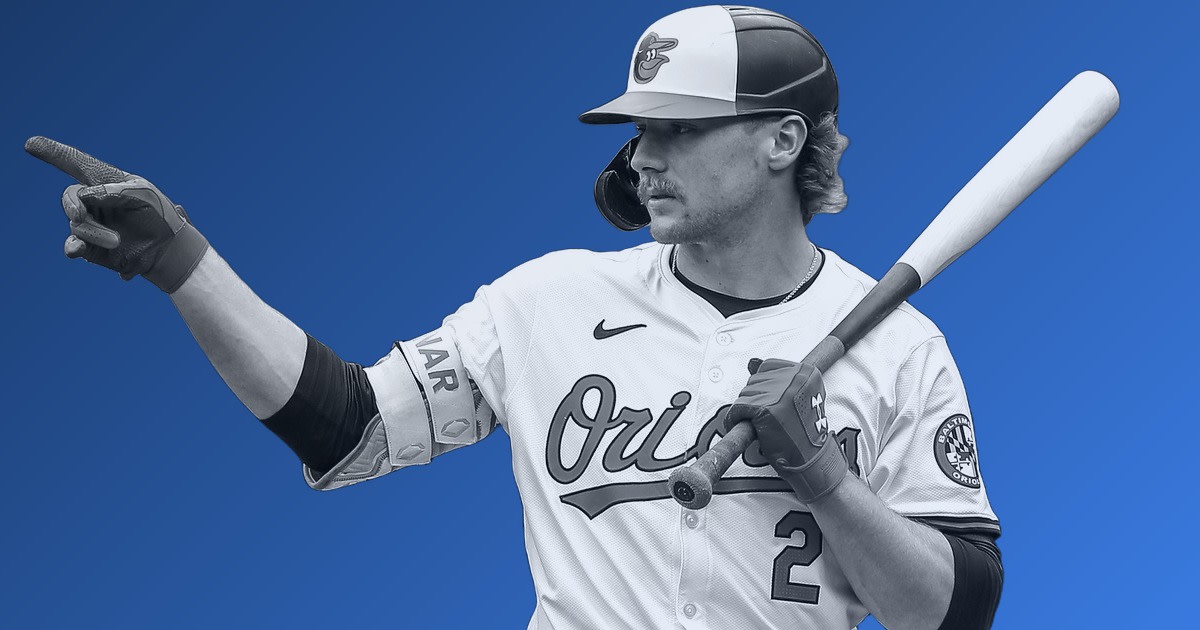

Three days ago, Gunnar Henderson stepped into the box against Luis Severino in a World Baseball Classic semifinal, down a run. He launched a 400-foot homer to right field to tie the game, part of a tournament where he led Team USA with a .400 average and a 1.267 OPS. This stat line was the 14th best of all hitters at the WBC. The semifinal homerun was the most authoritative swing we've seen from Henderson since the summer of 2024.
The timing matters, because 2025 was a confusing season for Gunnar. The home runs got cut in half: 37 in 2024, 17 in 2025. The slugging dropped 91 points to .438. The wRC+ fell from 154 to 120. On paper, it looked like a major step backward for a 24-year-old who'd just finished top-5 in AL MVP voting.
But there's a piece of the puzzle that wasn't public until January: Henderson revealed on the Orioles Hot Stove Show that he played through a shoulder impingement for roughly three-quarters of the season. "I could never get to the point that I wanted to get to with my swing," he said. The injury was particularly brutal against left-handed pitching, where his OPS cratered from .829 to .603.
He was still a good player, posting a 4.8-WAR shortstop with 30 stolen bases and a career-best strikeout rate. But the MVP-level power? It wasn't there.
We used the same FanGraphs regression methodology from our Adley Rutschman analysis to separate real changes from noise. We compared Gunnar's 2022-2024 baseline (~1,581 plate appearances) against his 2025 season (657 PA), regressing each metric toward league average based on its stabilization point. The regression can't account for injury -- it treats all plate appearances equally -- but it can tell us exactly which metrics declined and by how much, giving us a roadmap for what a healthy Henderson needs to recover.
The verdict: the power decline was real, the shoulder explains a lot of it, and the WBC suggests the recovery is already underway.
The Good News: K% Keeps Improving
Let's start with the most encouraging trend in Gunnar's profile, because it matters more than you think.
Year | K% |
|---|---|
2022 | 25.8% |
2023 | 25.6% |
2024 | 22.1% |
2025 | 21.0% |
That's a steady, year-over-year decline in strikeouts from a high 25.8% whiff rate as a rookie to a 21.0% contact machine in 2025. His regressed K% dropped from 24.2% (baseline) to 21.0% (2025), a 3.2-point improvement with high confidence. Strikeout rate stabilizes at just 60 plate appearances, and Gunnar has 657 PA in the 2025 sample. This is as real as it gets.
His zone contact rate backs it up: 83.5% in 2025, up from 80.9% baseline (regressed). When pitchers throw strikes, Gunnar is putting the bat on the ball more than ever. His whiff rate stayed essentially flat (25.8% regressed baseline to 24.9% in 2025).
The problem? He's making more contact, but it's not the right kind of contact.
The Bad News: The Power Metrics Declined for Real in 2025
Here's where the regression analysis is telling. Unlike Adley's 2025, where expected stats told a much rosier story than actual results, Gunnar's power decline shows up in every quality-of-contact metric, and the regression confirms it's not noise.
Barrel Rate: 11.2% to 8.5% (-2.7 points)
Barrels are the highest-value batted balls in baseball, characterized as having an exit velocity 98+ mph at optimal launch angles. Gunnar barreled 11.4% of his batted balls in 2023 and 11.2% in 2024 which can be classified as consistent, above-average power. In 2025, that dropped to 8.5%. Barrel rate stabilizes at just 40 BIP, and Gunnar had 441 in 2025, so this metric is well past the "could be a fluke" threshold. The regression confirms it: even after pulling toward league average, it's a real decline.
Hard Hit Rate: 53.9% to 49.2% (-4.7 points)
This is the single largest confirmed decline. Gunnar went from hitting the ball 95+ mph over half the time to under half the time. A nearly 5-point drop in hard-hit rate with high confidence (stabilizes at 40 BIP) tells us the raw power output genuinely diminished.
Year | Hard Hit% | Barrel% | Sweet Spot% |
|---|---|---|---|
2022 | 53.7% | 9.8% | 25.6% |
2023 | 52.0% | 11.4% | 32.9% |
2024 | 53.9% | 11.2% | 34.5% |
2025 | 49.2% | 8.5% | 29.9% |
Sweet Spot%: 34.5% to 29.9% (-4.6 points raw)
Sweet spot percentage (launch angle between 8-32 degrees) actually declined more sharply than the regression model suggests. Savant has Gunnar at 34.5% in 2024 and just 29.9% in 2025, a nearly 5-point drop. The regression pulls this toward "stable" because sweet spot% has a relatively high estimated stabilization point, but the raw number is worth watching.
It's worth noting that all three of these metrics: barrel rate, hard-hit rate, and sweet spot%, are exactly the kind of thing a shoulder impingement would suppress. A hitter who can't fully extend through the zone is going to produce less power on contact, even if his pitch recognition and bat-to-ball skills are intact. That's precisely what we see here.
The Fly Ball Problem: Fewer Flies, More Popups
Gunnar's fly ball rate fell off a cliff in 2025. His regressed FB% dropped from 25.3% to 21.7%, a 3.6-point decline, well past the stabilization threshold for batted ball types (80 BIP). Fewer fly balls means fewer home run opportunities.
But it's worse than just fewer fly balls. Savant classifies batted balls into four buckets: ground balls, line drives, fly balls, and popups. Fly balls and popups are both hit in the air, but the difference is launch angle. Fly balls leave the bat at an angle that can carry over the fence, while popups go nearly straight up and are almost automatic outs. Gunnar's problem isn't just that he's hitting fewer balls in the air. It's that the ones he is elevating are going straight up instead of out.
Year | FB% | Popup% | FB-to-Popup Ratio |
|---|---|---|---|
2022 | 15.9% | 3.7% | 4.3:1 |
2023 | 26.5% | 4.5% | 5.9:1 |
2024 | 23.6% | 4.4% | 5.4:1 |
2025 | 18.9% | 6.7% | 2.8:1 |
In 2024, Gunnar hit roughly 5.4 fly balls for every popup. In 2025, that ratio cratered to 2.8 fly balls to every popup. He's not just hitting fewer fly balls, a much higher percentage of the ones he hits are turning into outs. His regressed popup rate jumped from 4.9% to 7.3%, a 2.4-point increase.
This combination of fewer fly balls and more popups among those fly balls is the primary mechanical explanation for the home run collapse. Gunnar went from 37 HR in 2024 to 17 HR in 2025 on far fewer fly balls, with a much higher share turning into popups.
The Chase Rate Concern
There's one more red flag worth discussing: Gunnar started chasing more in 2025.
His regressed chase rate (swings at pitches outside the zone) jumped from 24.1% to 27.8%, which was a 3.7-point increase from 2024 to 2025. This was the second-largest confirmed change in his entire profile behind hard-hit rate. Year by year, the trend is clear:
Year | O-Zone Swing% |
|---|---|
2022 | 17.9% |
2023 | 26.5% |
2024 | 23.2% |
2025 | 27.7% |
Gunnar's rookie year featured good pitch selectivity (17.9% chase rate in a small sample). In 2024, he kept it in check at 23.2%. But 2025 saw a meaningful jump to 27.7%, approaching league average (28.2%).
More chasing means more swings at pitches he can't drive. It partially explains why his barrel rate dropped: you can't barrel up a slider two inches off the plate. The good news is that chase rate is considered a somewhat volatile metric (estimated stabilization around 150 pitches seen out of zone), and Gunnar's 2024 rate suggests he can be more selective. The question is whether 2025 was an aberration or a new pattern.
The Silver Lining: He Has a High Floor
Although we've been diving into some regression that could leave you a bit depressed, I want to reiterate that even in a "down" year, Gunnar Henderson was a 4.8-WAR player.
He stole 30 bases in 2025 (up from 21 in 2024). His sprint speed (28.5 ft/sec) ranks in the top tier of major leaguers. His defense at shortstop was a net positive. These are the tools that make him a valuable player even if the power never fully returns.
Year | HR | SB | WAR |
|---|---|---|---|
2022 | 4 | 1 | 0.8 |
2023 | 28 | 10 | 4.7 |
2024 | 37 | 21 | 7.9 |
2025 | 17 | 30 | 4.8 |
Even in the floor scenario, Gunnar's speed, defense, improved contact rate, and remaining power (he still hit 17 homers) make him a 4-5 WAR shortstop. That's a franchise player. The upside scenarios just determine how much of a franchise player.
2026 Scenarios
Floor (.430-.450 SLG, ~20 HR): The contact profile stays depressed. Barrel rate stays around 8-9%, fly ball rate stays low, popup rate stays elevated. He's essentially 2025 Gunnar again: a high-contact, low-power shortstop who runs well and plays good defense. Still a 4-5 WAR player, still an everyday starter. But the MVP ceiling is gone.
Likely (.470-.500 SLG, ~25-30 HR): Partial recovery in barrel rate and fly ball rate. The popup spike regresses (6.7% was a career outlier). He doesn't get all the way back to 2024, but splits the difference with something like a 10-11% barrel rate and 22-23% fly ball rate. This version of Gunnar is a 5-6 WAR shortstop: not quite MVP-caliber, but firmly in the All-Star tier. Think 2023 production with better contact skills.
Ceiling (.520-.540 SLG, ~35 HR): Full 2024 restoration. The fly ball rate climbs back above 23%, the popup rate drops to 4-5%, and the barrel rate returns to 12%+. He pairs 2024-level power with 2025's improved K% and contact rate. This is the best and scariest version of Gunnar Henderson, and it's an MVP candidate. This version of Gunnar is possibly even better than 2024 because he's striking out less. A 7-8 WAR season (maybe even better).
We take pre-season numbers with a grain of salt, but his WBC performance: posting a team best .400 average, two homers and 1.267 OPS against great international pitching is exactly what this scenario looks like in a small sample.
What to Watch in April
There are a few key metrics you can hone in on to track Gunnar's 2026 power recovery. Here are the four that we think matter most:
Barrel Rate. This is the single best indicator of power output. If Gunnar's barrel rate on Baseball Savant climbs back above 11% in the first few weeks, the power is coming back. If it stays below 9%, the decline may be structural instead of from the injury.
Popup Rate. The fly-ball-to-popup conversion was the mechanical smoking gun in 2025. Watch for his popup rate to drop below 5%, that would signal he's matching bat-to-ball properly again instead of popping it straight up.
Fly Ball Rate. Related to popup rate but tracked separately. Gunnar needs to get his fly ball rate back above 22-23% to have home run upside. If it stays below 20%, the power ceiling is capped.
Chase Rate. The pitch selectivity slide from 23.2% to 27.7% was concerning. If Gunnar's O-Zone Swing% drops back below 25% in April, the 2025 chasing was likely a temporary issue. If it stays above 27%, pitchers may have found a new way to exploit him.
The Bottom Line
Gunnar Henderson's 2025 power decline showed up in the data: fewer barrels, fewer fly balls, more popups, more chasing. The regression analysis confirms these weren't flukes.
But for a player with such a high floor, the full picture is more encouraging than the raw numbers suggest. He played through a shoulder impingement for three-quarters of the season, an injury that, by his own admission, prevented him from getting to where he wanted to with his swing. His strikeout rate improved for the fourth straight year. His zone contact rate hit a career high. He stole 30 bases and played solid shortstop defense. Even compromised, he was a 4.8-WAR player.
And then the WBC happened. Healthy and unencumbered, Henderson led Team USA with a .400 average, two homers, and a 1.267 OPS against some of the best pitching in the world. That 400-foot bomb off Severino in the semifinals didn't look like a hitter whose power had disappeared. It looked like a hitter who got healthy.
The most likely version of Gunnar Henderson in 2026 is somewhere between his 2023 and 2024 selves: a 25-30 home run hitter with improving contact skills, elite speed, and above-average defense. That's at least a 5-6 WAR shortstop and one of the most valuable players in the American League.
The MVP ceiling is still there. He's 24 years old, fully healthy for the first time in over a year, and he just showed us what that looks like on the biggest stage in international baseball. The best is probably still ahead and we can't wait to see him post big numbers here in 2026.
Analysis based on Baseball Savant Statcast data through March 2026. Regression methodology per FanGraphs and Baseball Prospectus research.