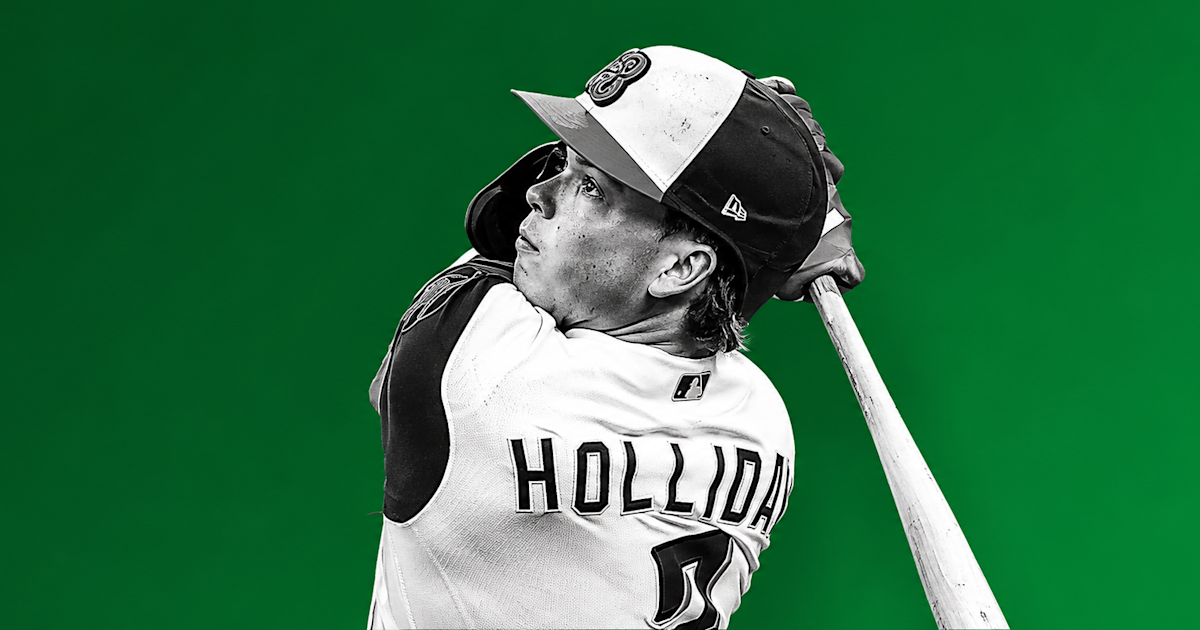

Within a 24-hour window in early February, three starting position players for three different major league teams went under the knife for similar procedures: corrections to their hamate bone. Corbin Carroll and Francisco Lindor on February 11th, Jackson Holliday on February 12th. Five months into the 2026 season, the three outcomes for these players look nothing alike.
The hamate hook is a small protrusion of bone that sits directly beneath the bat handle in the bottom hand. Hitters fracture it when a ball jams into the grip and a vibration transfers straight into the hook. It's also prone to take on a lot of stress from repeated swinging and movement, especially for baseball players that swing a baseball bat daily. For excision, surgeons remove the fragment rather than repair it, and the bone is simply gone. For most players, batting contact returns quickly, but a hitter's power profile takes more time to recover. The initial recovery process usually takes weeks, rather than months.
However, in a mini case study, it has taken varying lengths of time for these three players' hitting arsenals to return to pre-injury form. For one of these three players, it took one month. For another, the surgery was the beginning of a separate cascade of problems. For the third, it took most of the first half of the season, and what's unfolding in the last 30 days may be the most encouraging sign that the recovery is finally complete.
The Recovery Window
Carroll and Lindor returned on Opening Day, March 26th, in a speedy forty-three days from surgery to first plate appearance. Both made their teams out of spring training and both were cleared in time for the season. These two were expected to be productive contributors from day one.
Holliday was not. His 2026 debut came on May 18th, 101 days from injury, 96 days from surgery. The difference wasn't the severity of the initial fracture. It was what happened during his recovery: three separate rehab assignments in Norfolk and Bowie, each disrupted by recurring soreness at the excision site. The bone fragment was gone, but the area around it wasn't healing on schedule. By the time Baltimore activated him in mid-May, the season was already 40 games old.
Lindor's case requires a footnote. He made Opening Day clean, but 28 games into the season he landed on the injured list with a left calf strain, a separate injury that had nothing to do with the hamate. That absence ran from April 23rd through June 24th, 62 days. His hamate recovery looked complete, but his 2026 season still got derailed.
For our mini case study, we decided to take a snapshot of each of these three players' first 24 games back from this injury to see their progression.
First 24 Games Back: The Dichotomy
The research literature on hamate excision says contact returns before power. The grip strength required to drive the ball with authority, particularly on inside pitches, which sit precisely where the hook used to be, takes longer to rebuild than the general hand control needed to make contact. That pattern has shown up consistently across the documented cases over the last decade.
Corbin Carroll decided he was going to ignore this research entirely.
Carroll's .566 SLG in his first 24 games back is the number that stands out. He was hitting for power from week one. He recorded three home runs in this stretch and a slugging percentage that would lead most lineups. He went on to make the NL All-Star team in July without a single IL stint. His hamate recovery was, by every observable measure, complete before the season started.
The Carroll-Lindor contrast is especially striking because the two players had identical surgery dates and identical return dates, yet produced outcomes 297 OPS points apart. Lindor's .355 SLG in those same first 24 games reflects the textbook hamate pattern, the contact came back (.226 average, reasonable strikeout rate), but the power lagged. Interestingly, both Carroll and Lindor hit 31 home runs in 2025, so both exemplify a hitter that can hit for power, when healthy.
Holliday's case sits at the far end. His .197 average and 29.3% strikeout rate over the first 24 games is what a player looks like who is still working through physical discomfort. The three home runs, which was a higher total than Lindor's in those 24 games, are something of an anomaly, likely a function of a few well-timed pull-side mistakes rather than restored grip strength. His walk rate of 11.0% was suppressed relative to his established profile. Hitters grinding through hand pain expand the zone, not shrink it.
What Came Next
Carroll kept hitting. By the All-Star break he was one of the better offensive outfielders in the National League, his hamate surgery a footnote in a season that went exactly as projected.
Lindor's path was more complicated. His 24-game sample before the calf injury was the only sustained window his hamate recovery ever had. He returned from the IL on June 24th and has played well in the weeks since, but separating his performance into "hamate" and "not hamate" requires inference at this point. The two injuries overlap in the timeline enough that his full 2026 picture is difficult to read cleanly.
Holliday's arc after those first 24 games was nonlinear. Games 16 through 27 were the low point, a stretch where his strikeout rate spiked toward 40% and his walk rate collapsed, the kind of numbers that suggest a hitter was still trying to get his bearings on the 2026 season. Then something shifted.
The Last 30 Games
The version of Holliday that has shown up over the past 30 games is the one the Orioles were projecting when they took him as the 1st overall draft pick in 2022.
The OPS jump of .168 points from one half to the other tells part of the story. The walk rate tells a more specific one. An 18.5% BB% doesn't happen when a player is fighting through grip discomfort. It requires zone recognition, patience and the ability to take a pitch to the opposite field instead of committing early. That kind of plate discipline is the last thing to return when a hand isn't right.
The one thing still missing is power. One home run in 30 games, with a SLG (.405) that has barely moved from the first-half number (.400). The average and walk rate have both improved dramatically. The slugging has not. It is the same pattern Lindor showed in his pre-calf-injury window, just arriving five weeks later. Contact first. Power pending.
Although Holliday's plate profile isn't typically to hit for power, he did tie Gunnar Henderson and Jordan Westburg last year for team leader in home runs (17). With 53 games remaining in Baltimore's season, Holliday has enough runway to answer the power question. The research literature on hamate excision, Erickson et al., 2020, examining 261 players, finds that 81% of players return to the same or higher level of play, with grip strength typically stabilizing well into the first post-surgery season.
The Orioles will need his plate discipline and hitting profile if they are going to go on a run in this final stretch.
Data via MLB Stats API · Through July 29, 2026