

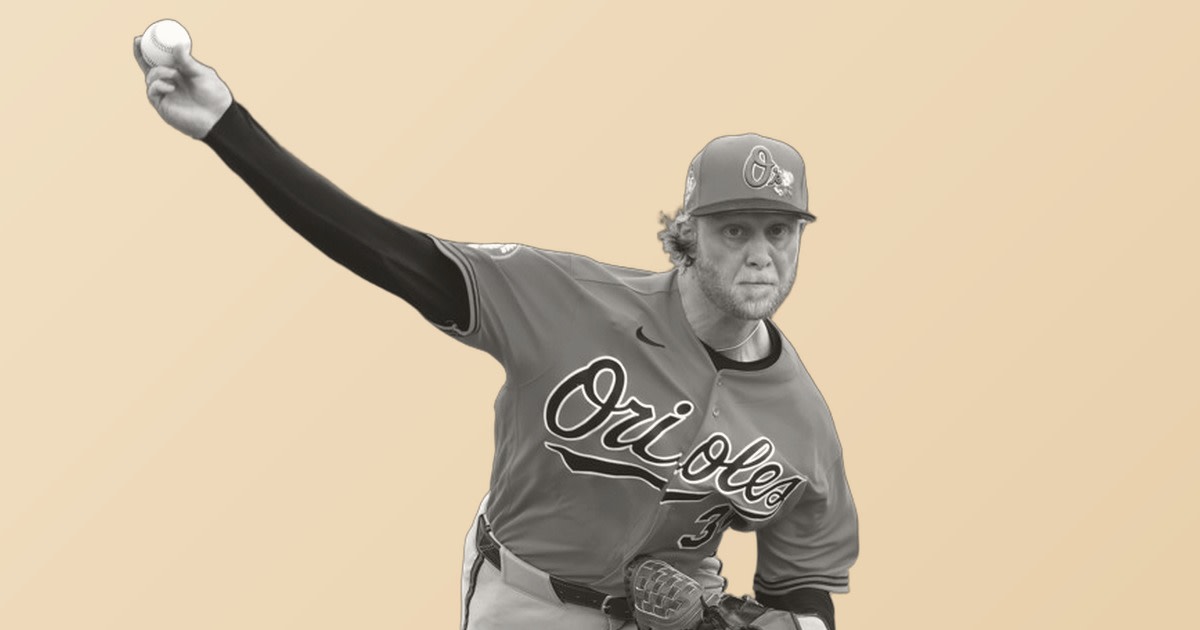
With the recent news of a five-year, $68 million extension for Shane Baz, it's fair to ask: What exactly do the Orioles see in him?
On the surface, the skeptics have plenty of ammunition. Last season, Baz pitched to a 4.87 ERA and a 1.33 WHIP with the Tampa Bay Rays. Furthermore, the Orioles have already made a massive investment in him, surrendering a haul of top-tier prospects: Caden Bodine, Slater de Brun, Michael Forret, and Austin Overn, along with a 2026 Competitive Balance Round A pick. At the time, many viewed this as a significant overpay for a pitcher with only one full healthy season under his belt.
His first official outing as an Oriole yesterday had it's ups and downs. In 5 and 1/3 innings, he threw 78 pitches and allowed 4 earned runs on 7 hits with 4 strikeouts and no walks (1 HBP). He pitched into some trouble in the 2nd inning, allowing all four of his runs in that frame. But his stuff looked good, and the promise that the O's front office is betting on was on display at times.
The Small Sample Size Gamble
It is important to remember that most of what we "know" about Baz as a Major League workhorse comes from a single year of data. Prior to 2025, Baz had thrown just 135.2 big league innings across four seasons, largely due to a two-year hiatus for Tommy John surgery. Because of this lack of a historical baseline, identifying true "trends" in his numbers is notoriously difficult. Almost all the analytical optimism surrounding him is built on the foundation of his 166.1 innings in 2025, making 2026 a high-stakes test. It will be fascinating to see if Baz can replicate those elite underlying metrics or if the league will adjust to him as his sample size grows.
Anchoring the New Era
Historically, the Orioles have been notoriously allergic to long-term pitching contracts. Before this deal, the largest contract ever given to a pitcher in franchise history was Alex Cobb's $57 million deal in 2018. Under the new David Rubenstein ownership group, that pattern is officially dead.
The Baz extension is the latest pillar in a massive organizational shift. While the team officially kicked off a "winter spending spree" by landing Pete Alonso on a record-shattering five-year, $155 million deal, the commitment to elite talent started even earlier. Last August, the front office made a brilliant pre-emptive strike by locking up 21-year-old phenom Samuel Basallo to an eight-year, $67 million extension. By adding Baz to this core, Baltimore has successfully transitioned from a "rebuilding" mindset to a "powerhouse" philosophy.
The "True" Baz: A Tale of Two Venues
If you want to know why the Orioles ignored Baz's 4.87 ERA, you only have to look at his 2025 home/road splits. Last season, the Rays played at George M. Steinbrenner Field, a spring training facility in Florida that played like a high-altitude launchpad.
Pitching Metric | Home | Away |
|---|---|---|
ERA | 5.90 | 3.86 |
AVG | .271 | .227 |
Home Runs Allowed | 18 | 8 |
wOBA | .355 | .303 |
The data is jarring. Baz allowed more than double the home runs at home than he did on the road. In a professional Major League environment like Camden Yards, which is far more neutral than a Florida spring training park, his "road" stats are likely to become his new baseline.
Mirrored Tunneling: The 1-to-7 Clockface
The reason Baz is so difficult to hit isn't just the velocity; it's the pitch tunneling. His four-seam fastball and knuckle-curve are perfect "mirrors" of each other. In 2025, his knuckle-curve spin reached a career-high 2,662 RPM, up nearly 200 RPM from 2024, giving the pitch more bite and making the tunnel even harder to read. The results showed up in his chase rate: hitters swung at pitches outside the zone 29.3% of the time, nearly matching his elite 2021 rate (30.5%) after dipping to 24.0% in 2024.
The Spin Axis: Baz releases his fastball with a 1:00 spin axis, giving it that elite "ride" at the top of the zone. His knuckle-curve, meanwhile, comes out on a near-identical 7:00 axis.
The "Tunnel" Effect: Because the two pitches are spinning on the same axis, just in opposite directions, they look identical to a hitter for the first 30 feet of their flight. A batter has to decide whether to swing at mid-to-upper-90s heat or an 85 MPH curveball, and by the time they realize which is which, it's too late. This "1-to-7" relationship creates one of the most effective tunnels in modern baseball.
The Missing Piece: Using the Sinker to Ground the Fly-Ball Issue
Perhaps the most exciting development of 2026 Spring Training is Baz's adjusted arsenal. In 2025, Baz induced fly balls or line drives on 53.2% of balls in play. To combat this, he has debuted a 96 MPH sinker.
What's interesting is that the ground ball shift was already underway. Baz's ground ball rate jumped to a career-high 47.0% in 2025, up from 39.3% in both 2021 and 2024, and the average launch angle against him cratered to 10.7 degrees, down from 18.1° the year before. Hitters were already getting on top of his stuff. The sinker doubles down on this trend: by attacking the bottom of the zone with triple-digit heat alongside his top-of-zone four-seamer, Baz can push that ground ball rate even higher and significantly lower his HR/9 at the more neutral Camden Yards.
Effortless Power vs. The Hard Contact Risk
The $68 million investment, while not "Ace" money in today's market, is a major show of faith in Baz's smooth and effortless delivery. Since returning from surgery, he has simplified his mechanics by throwing primarily from the stretch, creating a repeatable, fluid motion that minimizes arm stress while fueling an elite 9.52 K/9.
However, this delivery hasn't yet solved his command issues. Last season, Baz sat in the 32nd percentile in Walk Rate (9.0% BB%), often losing his rhythm and gifting free passes. The trend is moving the wrong direction: his walk rate has climbed in every full season (6.1% to 7.7% to 8.5% to 9.0%) and it's the most concerning trajectory in his profile. More worrying was his 28th percentile Barrel %; when hitters did make contact, they squared him up at an alarming rate. The Orioles' bet is that the new sinker and a repeatable delivery will bridge the gap between his elite strikeout stuff and his tendency to surrender hard contact.
The Verdict
The Orioles aren't paying for the 4.87 ERA pitcher of 2025; they are paying for the 26-year-old with effortless mechanics, a career-high knuckle-curve spin rate, and a developing sinker that could unlock his full potential. Even with an ugly ERA, Baz was worth 2.0 WAR last season thanks to the sheer volume of 166.1 innings across 31 starts, that's legitimate mid-rotation value. His 3.95 SIERA and a telling gap between his wOBA (.330) and expected wOBA (.306) both suggest he was one of the unluckiest pitchers in baseball last year—a pitcher whose actual results lagged well behind what his stuff deserved. By locking him up through 2030 alongside Basallo and Alonso, Baltimore has officially secured the hopeful anchor of its next championship window.