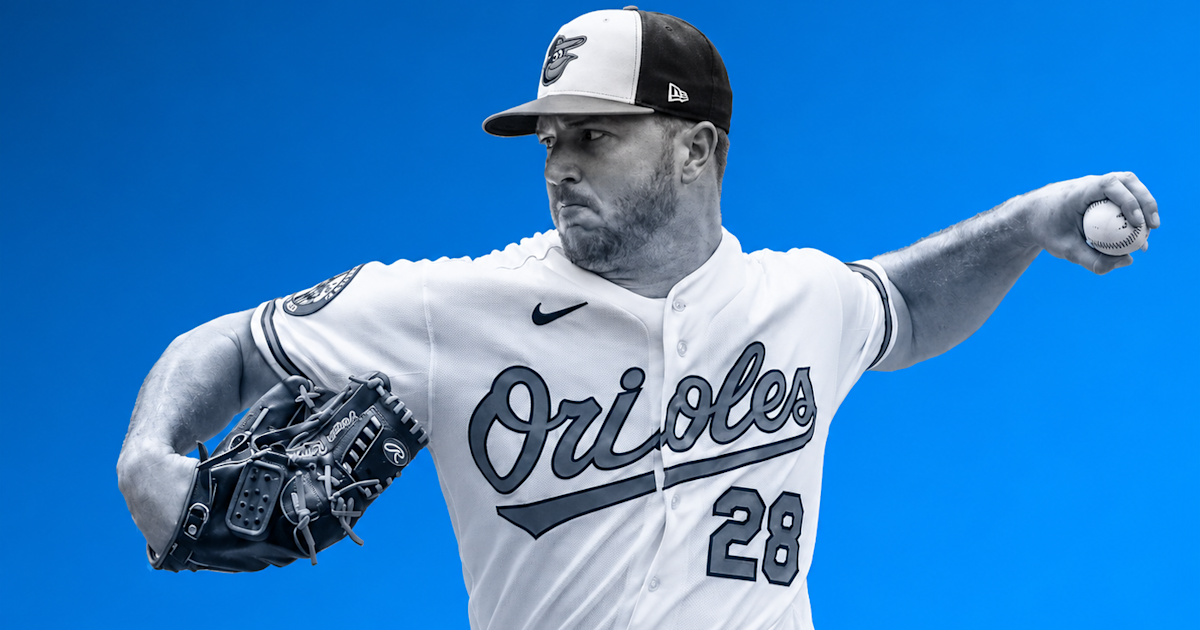

Thus far, Trevor Rogers has spent 2026 impersonating two different pitchers. One ended May with a 6.84 ERA. The other one-hit the Dodgers in late June, retired 20 of 23, and outdueled Yoshinobu Yamamoto in his own stadium. The calendar doesn't care which one is real. Rogers hits unrestricted free agency in November, the same month he turns 29, and the Orioles have spent a full year declining to talk about it.
Rogers is playing this year on a $6.2 million arbitration deal. Back in March, Baltimore extended Shane Baz for roughly $60 to $70 million, the same range projections had penciled in for Rogers. Over the offseason we signed Chris Bassitt and Zach Eflin while never once engaging the reigning Most Valuable Oriole, a pitcher who finished ninth in AL Cy Young voting across just 18 starts and who, at Baz's press conference, volunteered that he's willing to negotiate midseason. We've seen this movie before: this club ran the same experiment with Corbin Burnes (fortunately dodging the TJS bullet) then spent the following winter rebuilding from pieces.
One pitcher, two coin flips
The 2026 season has been similar to three seasons stapled together: three quality starts and a 1.89 ERA out of the gate, a seven-start crater from mid-April through late May at a 10.01 ERA, all seven losses, then a June recovery capped by the Dodger Stadium one-hitter. He came off that West Coast trip with a season ERA just south of 5.00. Nobody should believe that number, just like nobody should've believed last year's 1.81. In 2025 Rogers beat his xERA by 1.6 runs, riding a .226 BABIP and an 84 percent strand rate. In 2026 he's undershot his xERA by nearly a run, dragging a strand rate in the low 60s against a league norm near 72 and a BABIP back up to .296. The misses are nearly symmetric, which is what sequencing luck is really like. From his June 2025 recall through the Los Angeles gem, he's posted a 3.20 ERA and a mid-3.00s blended FIP across 32 starts and 182.2 innings. That two-year run is the asset.
The three doors
Baltimore's options between now and November form a decision tree, and two of the branches are bad. Door one is a deadline trade. Rental starters with ERAs above 5.00 don't return headline packages, because deadline buyers weigh the ERA as much as the underlying metrics. Door number two is riding out the season and extending a qualifying offer. That costs north of $22 million for one year if he accepts, and returns a lone compensation pick, maybe $10 million in surplus value, if he declines and walks. Lastly, the third and best option, in my opinion, is extending him yesterday. Every quality start from here raises his price, and June's underlying numbers say more are coming.
What honesty requires
The risk case should shape the years, not kill the deal. His strikeout rate has slipped below seven per nine, and that matters because strand rate regresses while strikeouts don't. The stellar results lean on luck, and he doesn't have the whiffs to backstop them when it fades. The fastball sits at 93, which leaves no cushion when command wobbles, as the spring crater showed. He's never thrown more than 133 innings in a big league season, with a knee, a biceps, a lat, and a back already in the file, and now he's tracking toward a career high, which cuts both ways: durability proof the market wants, and a fresh fatigue risk in the same breath. This probably isn't a pitcher you hand six or more years.
What the offer should be
Four years, $68 million, 2027 through 2030, his age 29 through 32 seasons, plus a $19 million club option for 2031 with a $3 million buyout. That's $71 million guaranteed at a $17 million AAV, with a $1 million escalator on each remaining year whenever he clears 160 innings, tying the extra dollars to the one thing he's never proven: volume.
Why this number? Because the AAV undercuts the qualifying offer, Baltimore's own fallback. Projections split the difference on Rogers at roughly two wins a season, about $18 million of annual market value, so the guarantee breaks even if 2026's expected stats are the whole truth and prints surplus if any fraction of 2025 was skill. The downside is capped at four years; the upside is a frontline lefty's second act at a mid-rotation price. And internally, Baz has set the floor.