
The Problem: Raw Stats Lie
A player hits .180 over his first 50 at-bats. Is he a bad hitter? Another player hits .350 over the same stretch. Is he elite?
The answer to both: we don't know yet.
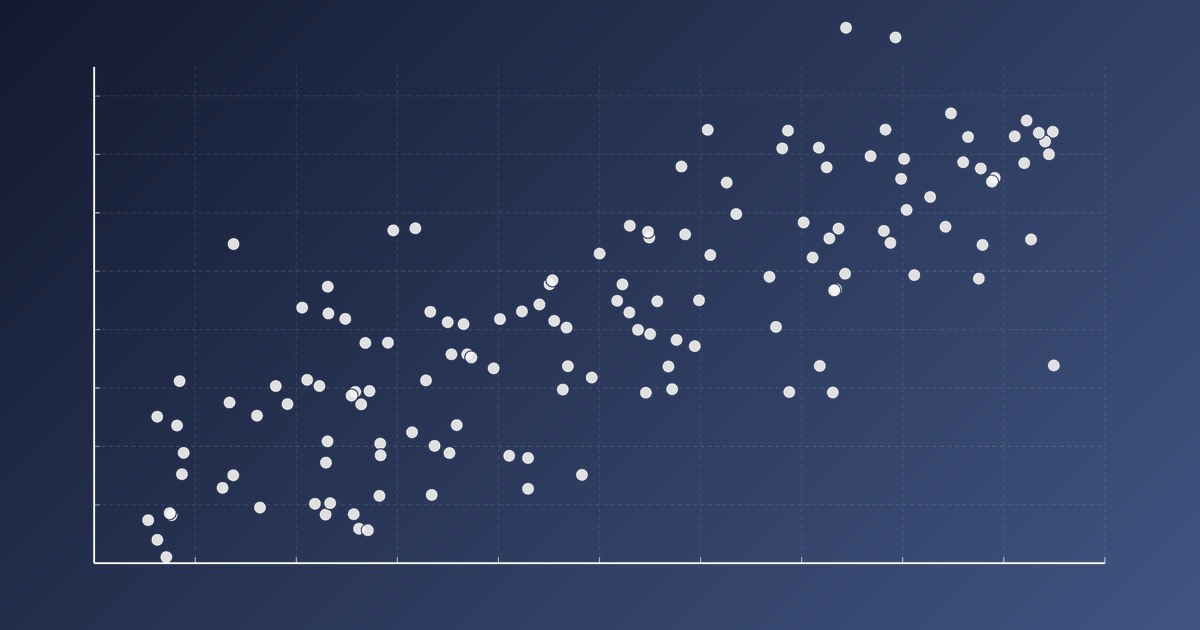
Raw statistics don't perfectly reflect a player's true ability—they contain both signal (skill) and noise (randomness). Smaller samples contain more noise. A .180 hitter might be unlucky; a .350 hitter might be running hot. The challenge is figuring out how much of what we observe is real.
This is where stabilization and regression come in.
What Is Stabilization?
Stabilization refers to the sample size at which a statistic becomes reliable enough to reflect true talent. FanGraphs research has established these thresholds empirically by measuring when a metric reaches a 0.7 correlation (R² of 0.49) with itself in a future sample.
As FanGraphs notes: "A statistic doesn't stabilize, it becomes more stable"—these are not hard cutoffs but points where reliability meaningfully improves.
Official FanGraphs Stabilization Points
These are derived from peer-reviewed sabermetric research:
Metric | Stabilization Point | What It Means |
|---|---|---|
K% | 60 PA | Reliable after ~2-3 weeks |
BB% | 120 PA | Reliable after ~1 month |
GB% | 80 BIP | Reliable after ~1 month |
FB% | 80 BIP | Reliable after ~1 month |
LD% | 600 BIP | Requires nearly a full season |
BABIP | 820 BIP | Requires more than a full season |
Source: FanGraphs Sabermetrics Library
Statcast Metrics: Baseball Prospectus Research
Russell Carleton's research at Baseball Prospectus established stabilization for Statcast batted ball metrics:
Metric | Stabilization Point | Reliability | Source |
|---|---|---|---|
Exit Velocity | 50 BIP | α = .732 | |
Barrel% | 50 BIP | r = .70 | |
Hard Hit% | 50 BIP | ~.70 (inferred) | Inferred from exit velocity research |
Estimated Stabilization (No Published Research)
Some metrics lack formal stabilization research. These estimates are based on similar event frequencies:
Metric | Estimated Point | Confidence |
|---|---|---|
Whiff% | ~150 swings | Lower |
Chase% | ~150 pitches | Lower |
Sweet Spot% | ~50 BIP | Lowest (no research exists) |
Important: Conclusions drawn from metrics without published stabilization research carry less weight. Sweet Spot% in particular has no empirical basis for its stabilization point.
Regression to the Mean
Once we understand stabilization, we can apply regression—the statistical technique for estimating true talent from observed performance.
The Core Concept
Imagine a player with a 15% K% over 60 PA. The stabilization point for K% is 60 PA. This means his observed rate is about 50% signal and 50% noise. We should regress his K% halfway toward league average.
The more PA he accumulates beyond 60, the more we trust his observed rate. At 600 PA (10x the stabilization point), his K% is roughly 91% signal—very little regression needed.
The Formula
FanGraphs uses this regression formula:
True Estimate = (observed_events + league_avg × stabilization_point) / (sample + stabilization_point)
Example: A player has 100 strikeouts in 659 PA (15.2% K%). League average K% is 22.2%, and the stabilization point is 60 PA.
Regressed K% = (100 + 0.222 × 60) / (659 + 60)
= (100 + 13.3) / 719
= 15.8%
His true talent K% estimate is 15.8%—slightly regressed toward league average because even 659 PA contains some noise.
Regression Weight
The formula effectively adds "pseudo-observations" at league average equal to the stabilization point. This means:
Sample Size | Regression Toward League Avg |
|---|---|
Equal to stabilization point | 50% |
2x stabilization point | 33% |
5x stabilization point | 17% |
10x stabilization point | 9% |
The larger the sample, the less regression applied.
Comparing Across Time Periods
When evaluating whether a player has changed, we compare regressed estimates between periods—not raw statistics. This accounts for sample size differences.
Interpreting Changes
When comparing regressed estimates:
Change | Interpretation |
|---|---|
< 2 percentage points | Stable — Within normal variance |
≥ 2 percentage points | Changed — Likely real, worth investigating |
This 2% threshold is a practical guideline, not a statistically derived cutoff. Even metrics showing >2% change may still be within normal variance.
Confidence Levels
Category | Criteria | Example |
|---|---|---|
High | Official stabilization, both periods fully stabilized | K% comparison with 500+ PA in each period |
Medium-High | Research-backed stabilization, both periods stabilized | Hard Hit% with 200+ BIP in each period |
Medium | Official stabilization, one period partially stabilized | BABIP with one period at 54% stabilization |
Lower | Estimated stabilization | Whiff% comparison |
Lowest | No published stabilization research | Sweet Spot% |
Common Pitfalls
1. Comparing Raw Stats
Wrong: "His K% went from 16% to 19%—he's striking out more!"
Right: Regress both periods, then compare. The change might disappear or become more pronounced.
2. Ignoring Sample Size
Wrong: "His BABIP crashed from .310 to .240 in the second half!"
Right: BABIP needs 820 BIP to stabilize. A half-season is maybe 250 BIP—only 30% stabilized. Heavy regression required.
3. Treating All Metrics Equally
Wrong: "His Sweet Spot% dropped 5%—major red flag!"
Right: Sweet Spot% has no published stabilization research. This finding carries the lowest confidence.
4. Binary Thinking
Wrong: "He has 59 PA, so his K% isn't stabilized and we can't learn anything."
Right: Stabilization is a continuum. 59 PA is 98% of the way to stabilization—the metric is quite reliable, just not fully.
League Averages Reference (2025 MLB)
For regression calculations, we use current league averages from the previous season:
Metric | League Average | Source |
|---|---|---|
K% | 22.2% | Baseball Savant |
BB% | 8.4% | Baseball Savant |
GB% | 43.0% | Baseball Savant |
FB% | 36.0% | Baseball Savant |
LD% | 21.0% | Baseball Savant |
BABIP | .300 | Historical average |
Whiff% | 25.3% | Baseball Savant |
Chase% | 28.2% | Baseball Savant |
Zone Contact% | 82.7% | Baseball Savant |
Hard Hit% | 40.9% | Baseball Savant |
Sweet Spot% | 34.1% | Baseball Savant |
Barrel% | 8.6% | Baseball Savant |
This methodology guide is designed for practical application to player analysis. All stabilization points and formulas are derived from published sabermetric research.