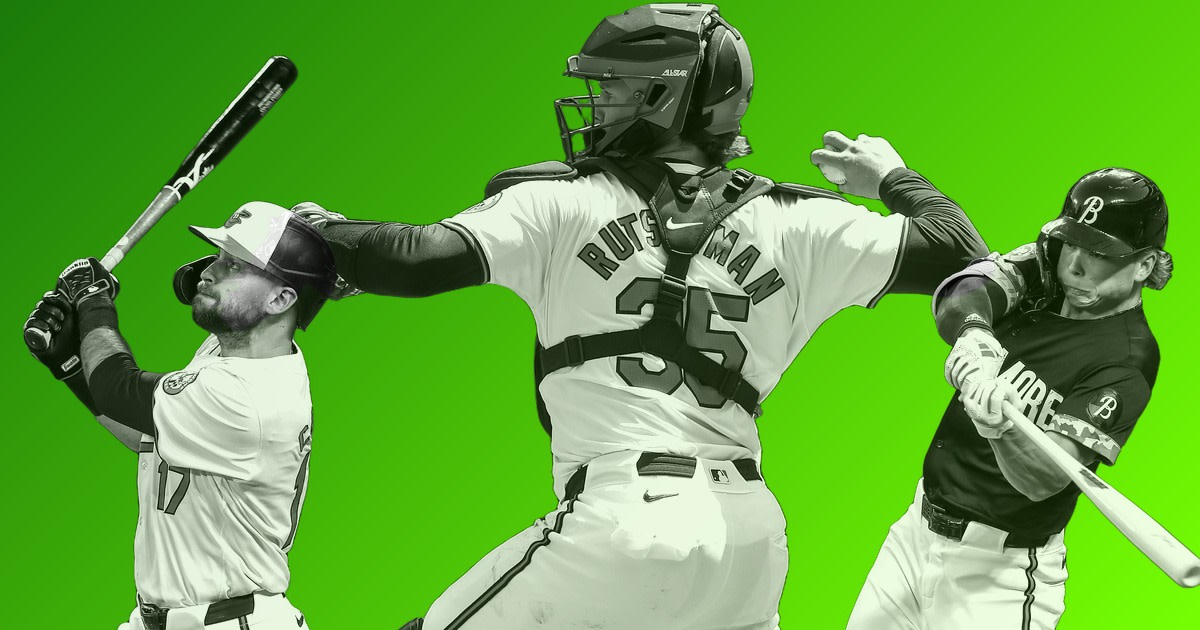

The wait is over. Finally, after months of projections based on preseason estimates, roster math, and historical ELO ratings, the 2026 season starts today. The model already captured the data from last night's game between the Yankees and Giants. Starting tomorrow morning, the model absorbs real game data for the Baltimore Orioles and the projections start meaning a lot more.
Before first pitch, here's where things stand after this morning's 10,000 simulated seasons and what we'll be watching as April unfolds.
The Headline Numbers
As of this morning's model run, the Orioles project for 81 wins with a ~32% chance of making the playoffs. The full range spans from 73 wins (10th percentile) to 89 wins (90th percentile). That's a 16-game spread, which tells you just how uncertain the model is before real games are played. We talk about this uncertainty in our model explainer.
For context, here's the full AL East projection landscape entering Opening Day:
Team | Median Wins | Playoff Odds | 90% Range |
|---|---|---|---|
NYY | 88 | 73.8% | 80–95 |
TOR | 86 | 65.1% | 78–94 |
BOS | 85 | 60.5% | 77–93 |
BAL | 81 | 31.6% | 73–89 |
TB | 78 | 18.0% | 69–86 |
The Orioles sit fourth, seven games behind the Yankees at the median. But the distributions overlap enough that this isn't a settled race.
See the full win distribution charts →
Three Things That Could Push the O's Higher
1. Gunnar Henderson's power comes back.
I wrote about this at length in the Gunnar 2026 outlook, but it bears repeating on Opening Day: the gap between floor Gunnar and ceiling Gunnar is large. His barrel rate dropped from 11.2% to 8.5% in 2025, but he played through a shoulder impingement for most of the year. His WBC performance (.400 AVG, 1.267 OPS) suggests the power is back. If his barrel rate climbs above 11% and his fly ball rate gets back over 23%, we're looking at a 6-7 WAR shortstop. That alone could be worth 3-4 extra wins over the current projection.
2. The rotation stays healthy and Bradish delivers.
The model is projecting the rotation conservatively because of what happened in 2025. But this updated staff has a high ceiling. If Bradish pitches like a front-line starter, Eflin and Bassitt provide stability in the backend of the rotation, and mid-rotation starters like Baz provide good consistency, the run prevention could outperform what the model expects.
3. The young core bounces back: Cowser, Rutschman, and Holliday.
This is the upside case that doesn’t require any free-agent luck, it just requires Baltimore’s homegrown talent to play closer to their ceilings. Colton Cowser showed elite barrel rates (14.1%) and hard-contact ability in 2025, but a 35.6% strikeout rate after returning from a fractured thumb buried the production at an 83 wRC+. If he can cut strikeouts closer to 30% and let the power profile play, he’s a league-average or better outfielder who hits 20+ home runs.
Adley Rutschman’s 2025 was disappointing, with a 91 wRC+ and .307 OBP from a player whose entire value is built on on-base ability. But his walk rate held steady at 11%, suggesting the plate discipline is intact even if the results weren’t. A healthy full season with the bat catching up to the eye could push him back toward a .340 OBP and 115+ wRC+.
And then there’s Jackson Holliday, who played 149 games at age 21 and showed real growth: 17 home runs, a 21.6% strikeout rate, and a .314 OBP that hinted at what’s coming. He’s recovering from a broken hamate suffered in spring training, but if he returns healthy and takes the next developmental step, pushing his walk rate above 9% and his OBP toward .320, the Orioles have a premium middle infielder on a rookie contract.
Combined, bounce-back seasons from Cowser and Rutschman plus continued progression from Holliday could be worth 4-5 wins above what the model currently projects.
Three Things That Could Drag Them Down
1. The young core doesn't bounce back.
Henderson, Rutschman, Cowser, Holliday, Westburg: these are the players the franchise is built around. Most of them had disappointing 2025 seasons. If the bounceback doesn't materialize and the underlying Statcast numbers from 2025 were signal rather than noise, this lineup could struggle to score enough runs, even with the added boost of Pete Alonso and Taylor Ward in the lineup.
2. Injuries to key pitchers.
This is the obvious one, but it deserves emphasis. The model already penalizes teams for IL time based on WAR lost. If a top starter goes down early, that penalty kicks in immediately and the playoff odds drop fast. The Orioles have some rotation pitching depth (i.e. Dean Kremer), but a repeat of last year could surely tank their chances of a return to the playoffs in 2026.
3. The AL East is just too good.
Sometimes a team plays well and still misses the playoffs because the division is stacked. The model has three teams above 85 wins in the AL East. Even if Baltimore outperforms their 81-win projection and lands at 85, they could still be on the outside looking in. The margin for error in this division is thin.
Follow Along All Season
Starting tomorrow, the model updates every morning with the previous day's results baked in. The playoff tracker on the homepage shows real-time odds for every AL East team. The player benchmarks page tracks 10 core Orioles against their personalized stat targets with daily updates.
Happy Opening Day, Birdland. Let's go O's!